Forum Replies Created
Hi Tamara
Great to hear from you – congratulations on your new job. They are lucky to have you. I hope you are really enjoying the work now you have settled in a bit. It’s always a bit traumatic changing jobs until you get your feet under the table!
That’s only a little blip – I agree with Vally about the way they are acting, so it’s good news all round – I bet you were pleased about the chemistry results which mean he is improving. No-one could have done more to help their baby get better than you have – sweet Ashki is doing well.
Love & hugs from us all
Sheena, Worzel & Ollie xxxxx
Hi Leza
Please don’t worry about the PCV – it really does take time for the drugs to start working & patience is a virtue with this disease, much to all our frustration! Slowly, slowly. It’s really good news that she is stable – well done both of you. If Molly is eating well, more active & generally more like her old self, that is what really matters because it shows she’s improving.
You are getting much better information from the vets now – your insistence is really paying off. It’s difficult sometimes & you are doing the right thing.
Tummy problems are important too – I do agree with them about the risk with the aspirin if Molly has had tendencies for an upset GI tract regularly. I wish they had explained this to you start with & we would have known a bit more too. It would still be good to see the tests anyway, just in case something important flags up. This tummy trouble is also a very good reason to add in the sucralfate, as Linda mentioned. Sucralfate can heal ulceration & protect the GI tract from further damage & these drugs are very hard on the stomach etc. Ranitidine (Zantac) is also a tummy protector, so she does have something to help for now, which is good. You too can now become an expert on pee & poo!
I’m really pleased to hear you are getting Dr Dodds involved – she is incredibly knowledgeable & has many years experience dealing with this disease. You can trust her to give you the best advice – any blood tests or other information & Molly’s health history will help her immensely.
Hoping for a rise in PCV very soon.
Love & hugs to you both
Sheena & the boys xxxxx
Me again – we were typing at the same time, I expect. Good to know your vet has seen this before – it helps such a lot. If your vet is sure Molly does not need anti-clotting meds, that is fine – but please humour me & ask the questions again tomorrow. Maybe ask why she doesn’t need it instead? I appreciate how awkward this is.
Dogs who have bone marrow failure or extravascular haemolysis (rather than intravascular haemolysis) do not need usually anti-clotting meds unless transfused. If Molly has low platelets or a bleeding disorder, she should definitely not have aspirin. Without the blood results, we are struggling a bit. Sorry.
Sheena x
Hi Leza
We are also from the UK – we lived about 20 mins outside Oxford & moved to France in 2007, so I know exactly what you are saying. Fellow Blighty’s then! I think it depends on your relationship with your vet as to getting the results without specifically asking – we were very lucky that our vets were superb where we used to live, BUT goodness before that, I’ve had some not so good ones over there too. In my opinion, you should be entitled to any test results – you have paid for them, so they really do belong to you – I’m sure you could very politely insist on copies. I do remember being shown some in the past over there, but not being given a copy unless I asked. Anyway, you can get round that little problem, I’m sure.
We would really like to see any test results, especially any blood tests & pathology slides/smears – it would help us to help you. I had never heard of this awful IMHA until Worzel was diagnosed & had to do a lot of research & learn as much as I could as I wanted to know EXACTLY what I was dealing with. Some of the lovely people on this site helped me through that very bad situation & now it is my turn to help, I hope. Regarding the anti-clotting meds (again!), if you are unsure about anything, we can help if we could see those results in full. I know you will be forceful if you need to be – you will look after Molly, I have no doubt.
The UK does not have such a high incidence of IMHA as in other countries, probably because we don’t have so many tick borne diseases at the moment. But they do exist & no doubt it will get worse with global warming, animals travelling more, more vaccinations etc. This also means that vets don’t have the experience of seeing & treating the disease either – that’s no disrespect to them at all. It’s very rare, full stop. Your vets have done a really great job getting her through the first stages & hopefully will be open to suggestions too.
As Patrice mentioned, we are very interested in Molly eating snails – this definitely could be a trigger. I remember before I left the UK, that many more cases of something called lungworm (also called French heartworm – not to be confused with another type of heartworm we have here) were being reported in dogs, which is extremely dangerous. This worm is sometimes found on slug, snails & their slime & can cause blood abnormalities – has she had a recent cough at all? Some dogs can be infected, but have no symptoms. One of the several blood problems lungworm can cause includes hypochromic anaemia (which means pale coloured red cells with a low count) &/or bleeding problems. A possibility. Worth testing for maybe? – here’s some info:
http://en.wikivet.net/Angiostrongylosis
http://www.dfordog.co.uk/article-be-lungworm-aware.html
Last boring question bit – what antibiotics is Molly on & what for? That might give us a clue as to the cause too.
It’s wonderful to hear Molly is eating well – you will have to give her more food – my greedy boy was always ravenous on the pred too. Feed me, feed me NOW! I always feel happier when they get their appetite back & want to be a little more active. She is doing really well, Leza.
Let us know how you get on tomorrow – sending loads of hugs from me & my boys
Sheena, Worzel & Ollie xxxxx
Hi Leza and Molly. I am so sorry you are going through this but glad you found this site. Although, I have been gone way too much lately, I do check in, but seldom, lately, have time to write due to life getting in the way. But thank goodness for the others right now. We have been right where you are (Sadie’s Story) and are with you all the way. Ask away – nothing is too trivial.
All the posts and advice, of course, are right on for Molly- as it was for me and my Sadie – goodness, years ago. I did want to add, that Sadie was on aspirin until recently (we’re so low on the prednisone now, not needed), but was on human Plavix (Clopidogrel, generic) in the beginning. Her vet put her on it immediately upon diagnosis and with the beginning of her AIHA treatment, thank goodness.
Please continue to keep us posted and know that we are here for you and Molly. In the meantime, we are sending our love and hang-in-there hugs,
Linda and Sadie
Hello Pam and precious Ella. I am so sorry you are here, but SO glad you found this site. We have all been right where you are (Sadie’s Story) and we know how scared and confusing it all is – I was totally a dear in the headlights.
It sounds as though your vets have a good grip on this horrid disease AND that the communication is good – that’s key. We too, have been lucky enough to have a (well, several now) wonderful vet(s). And, as Ella, Sadie responded quite quickly to the regiment. BUT, she was weaned too fast, and lead to relapse. She again relapsed in October 2014. But she’s a fighter and doing well now, thank goodness.
You mentioned traveling with Ella. It’s a slippery slope and I totally agree with Patrice and Sheena – home is the best place. On occasion, I do take Sadie with me. Her last relapse was when I was staying with my grand children in GA (we live in FL). I had to take her to two vets there (knew one, not the other) and we immediately put her back on prednisone (alone) and that actually did the trick in just a few days. We now, again, are weaning very slowly from that relapse. Geeze.
I tell you this because, I so wish I would have take EXTRA medication (higher dose) for the “what if’s” and will for now on ALWAYS carry the 20mg prednisone with me when I travel with her, which now is not often. She was actually still weaning from the last relapse and was on a VERY low dose (2.5mg am only) of prednisone.
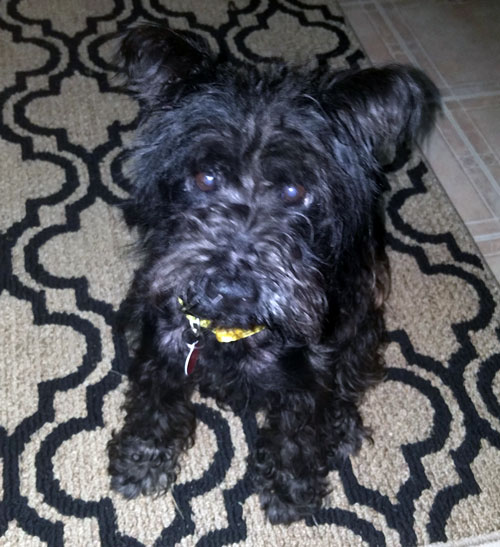
Also, I THINK, not sure, but I think she may have had fleas on her (she’s on no flea/tick medications now). It’s hard to check her because she’s jet black. My son has a huge back yard that Sadie loves to run in – AND roll in. Let’s see, GA. Yep. Fleas. So, perhaps that could have caused the anemia and hence, the relapse. And this year in FL has been equally as bad.
I am now trying to figure out just WHAT the heck we can use to keep the fleas off. I now use a flea comb (thank you Vally!), Food Grade Diatomaceous Earth and a product called Richard’s Organics Flea and Tick (it does NOT kill them, just stuns them and they fall off). I then put them in water and they drown, down the toilet. I put the Food Grade (ONLY) Diatomaceous Earth in her bed, in the area rugs where she lies and under our (high bed, it’s her domain under there – a huge tent) poster bed (high off the ground). Anywhere she lies. It’s a bit unsightly, but I think it’s really helping. I just bathed her and there was one flea (huge, but only one) – he’s toast now. So, it’s much better than the 30 I had found just a month ago.
Also, I wanted to say, it took me a while to realize I can not take her everywhere with me anymore. Yes, broke my heart – I travel much. I still take her to my son’s and my daughter’s home (both in GA), because she absolutely loves the grandchildren AND my daughter has Sadie’s sister, Sophie-dog, and they adore each other. My son has no animals, other than the wild children. :)
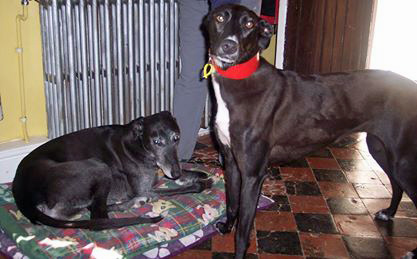
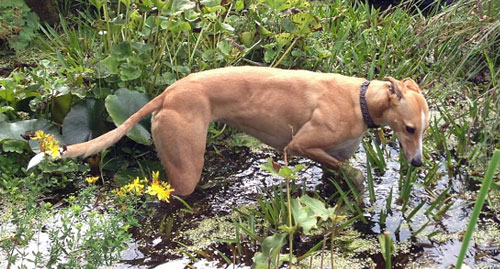
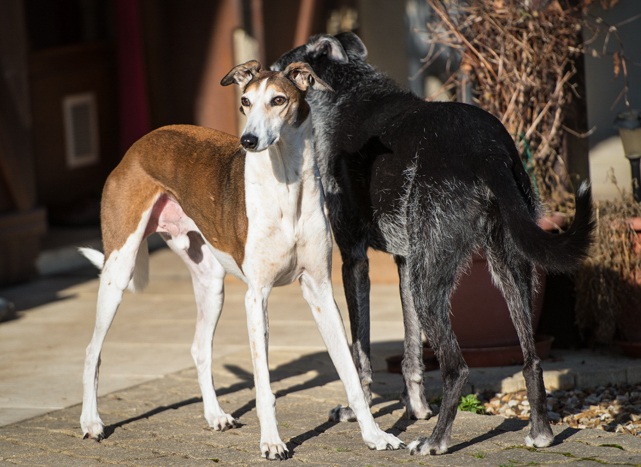
When I leave Sadie (as everyone else, no more dog parks, no kennels, etc.), she now stays with her ‘greyhound buddies’ down the street. The greyhounds’ (five of them) fur parents are the best and they know Sadie’s vet (he care for the greys, as they are part of a large greyhound rescue group here in Tampa). Sadie thinks she’s a greyhound (please don’t tell her otherwise….). They are hysterical together. I pay them, as I would a kennel, as a donation to the greyhound rescue – a tax write-off. It’s a win-win situation. Perhaps, you could find someone that would be willing to do something like this or even a barter system – you trade off. I have another friend that I do that with (Sadie, like me, loves all pups), another cocker spaniel, Buster – great buddies.
I am so glad that Ella is doing well. You are so right, the prednisone has horrible side affects. The muscle atrophy is really cruel. BUT, Ella’s muscle tone will come back. You will be amazed, as Vally, Patrice and Sheena have said.
Hang in there – you are doing a remarkable job, both of you!!! I know this brings about some lousy life changes, but Ella IS a survivor and your care and diligence is the reason why. I like the word “remission” (thanks Sheena!) – keep it up Ella!
Sending our love, Linda and Sadie
Hello Pam & Ella
So good to hear Ella is making wonderful progress. I always say my dog Worzel is “in remission” rather than “cured”. We often say on here that we are all in the crazy, paranoid world of IMHA! I do not let any other dogs in my garden or house now, we give him no vaccinations whatsoever & I am vigilant with Frontline Combo flea & tick treatment. We were fortunate to know that an infection caused Worzel’s bone marrow failure, but I am always aware that a relapse is possible. We are “stay at homes” now and I am happy doing that to protect my dear baby from harm. Like you, I also count my lucky stars every day that we still have Worzel with us. So I would not be taking Ella on any trips other than local ones if I were you. These drugs make them too prone to catching anything & everything going!
I know how worrying the risk of clotting is for you with Ella – it is always important to give anti-clotting meds & I see you are really on top of that, which is great. Take the pred reduction nice & slowly to avoid relapse risks – have a look at this:
https://www.secondchanceaihadogs.com/AIHA_Terms/prednisone-dose-reduction/
I really hope you too will soon be able to say Ella is in remission – I know you will be giving her the best possible care – your deep love for her shines through your messages. Do not fear a relapse – BUT do everything you possible can to avoid it during the drug reductions as it makes the treatment longer than necessary. Then keep a close eye out for anything suspicious – this is how I spend my life with Worzel! If in doubt, we go straight to the local vets.
Please let us know how Ella is doing – any worries or questions, you know you are always welcome to ask whatever you want.
Best wishes
Sheena, Worzel (in “remission”, diagnosed Dec 2012) & his best friend Ollie x
Hi Leza
As Vally says, the heavy breathing is usual when they are on prednisone – we’ve all seen that with our dogs too. And they are really tired, not wanting to do much – keep her nice & comfy & quiet for now. When the prednisone dose can be reduced (be patient on this too) this will pass & she will slowly get her energy back. I expect she will be a very hungry girl too – their appetite becomes huge! Worzel was eating tons more & was still losing weight (common). He soon got better though.
The abnormal clotting issue is vitally important. It isn’t just the transfusion that causes risks, it’s the disease itself. Most dogs, although not all, do need anti-clotting medications which sometimes need to be continued for quite a long time, I’m afraid, & I want you to be absolutely sure. Please look at this list of causes carefully – you can print it & take it to the vets if you want:
https://www.secondchanceaihadogs.com/AIHA_Terms/abnormal-clotting/
Spherocytes & auto-agglutination can be seen on a blood smear – a slide preparation that can be viewed under the microscope. There is also something called a Coombs Test. Your vet may have done these things, but please, please check to make sure to put your mind at rest (and mine!). I am a terrible nag about this because it is the biggest risk with this disease. If none of the things listed are present in Molly’s blood, she doesn’t need anti-clotting meds – if ANY of them are, she definitely does.
You can send us any results & we’ll have a look for you – sometimes a pathologist or vet has examined a blood smear & makes comments on the blood test results. Do you know if your vet has treated this disease before? Here is a Cornell University Veterinary study showing just how important anti-clotting medications are:
http://www.ncbi.nlm.nih.gov/pubmed/15934255?dopt=Abstract
Let us know how you get on – I know how difficult this is for you – hope this helps you to be able to discuss this fully with the vets.
Love Sheena x