Forum Replies Created
The more I read, the more I am convinced this is Atypical Addison’s Disease. I think the next step is to do an ACTH test. If this were me I would have it done soon. You really need to know what is going on. The symptoms around the dosage time for prednisone can’t be ignored. See if your vet agrees and if they do they may need him to be off the prednisone for a day?
http://www.petmd.com/dog/conditions/endocrine/c_dg_hypoadrenocorticism
Sheena, can you find that paper for Vally and send it to her? I’m a little tied up right now.
my best
patrice
Hope,
Dr. Dodds has written extensively on the thyroid. Hemopet provides comprehensive thyroid testing and diagnostics.
This first article is an interview with Dr. Dodds and discusses what the thyroid does and what happened in hypothyroidism. Please read this carefully.
http://www.whole-dog-journal.com/issues/8_6/features/15723-1.html
Dr. Dodds provides excellent diagnostics and you can read about that here.
http://www.hemopet.org/hemolife-diagnostics/veterinary-thyroid-testing.html
This explains how this Hemolife test is used to differentiate between a low thyroid caused by disease of the thyroid or by some underlying disease (non-thyroidal illness, NTI)
http://www.hemopet.org/hemolife-diagnostics/t4-ft4-ratio-thyroid.html
This table is excellent at showing how the values from the thyroid test can be evaluated to assess thyroid function. Right click on the image and View Image.
http://www.hemopet.org/hemolife-diagnostics/thyroid-diagnostic-table.html
my best
patrice
Roger,
I think it may be helpful for you to more fully understand the interplay between the humoral and cell-mediated immune system responses and especially when it comes to canine disease resistance.
https://www.secondchanceaihadogs.com/AIHA_Terms/humoral-immunity/
https://www.secondchanceaihadogs.com/AIHA_Terms/cell-mediated-immunity/
This paper written by Dr. Dodds and hosted by the Canine Epilepsy Guardian Angels website is a good start for anyone trying to wrap their brain around how things went so wrong in their dog.
The Canine Immune System and Disease Resistance
By W. Jean Dodds, DVM
http://www.canine-epilepsy-guardian-angels.com/ImmuneSystem.htm
After you read these over a few times you will probably have a lot of questions. Remember that what you have read is one small part of the whole. I can point you to more information once this sinks in.
Many people read this information with the thought that they are looking for the puzzle parts that point to how they did something wrong to their dog. This gut wrenching feeling is hardly avoidable but I want to reassure you, and I am sure Dr. Dodds would also reassure you, these aren’t anything you could have known about. Your responsibility is thwarted sometimes by the care that professionals provide to our dogs.
I started this website for the main purpose of providing education to owners so they can help, not hinder, the recovery of their dogs. I often feel the best start is with a blank slate in the department of guilt and moving forward with a fresh start. When this happens there is a feeling of relief and a strong sense of empowerment.
I did a number of things wrong with Chance, not because I did them intentionally, but because I just didn’t know and there was no one looking over my shoulder guiding me along the way. But once I realized I could “learn” my way out of the corner, I was empowered to help him.
my best
patrice
Sheena,
This is such great news! Those Greyhounds with their super high hematocrits! They are like another species altogether. I hope you have a big party tonight!
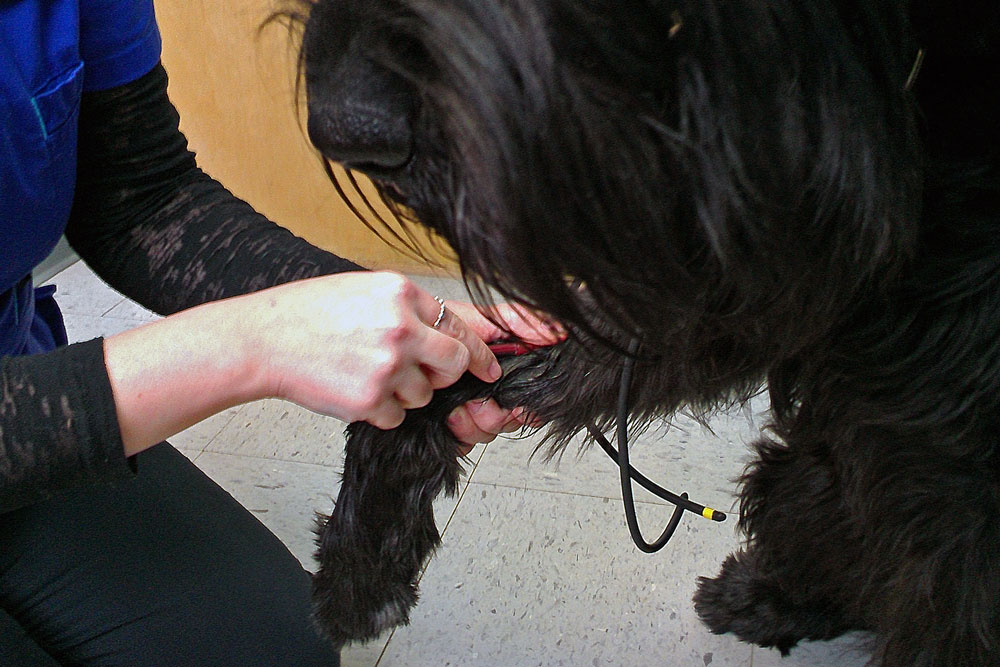
Does he like going to the vets to do the test? I’m wondering, do they collect from a leg? For donor Greyhounds they must have some routine location to collect from so they can rest during the process.
my best
patrice
Hope,
The normal brown coloring for normal stool comes from bilirubin in bile. Bilirubin comes from hemoglobin(the coloring of red due to iron content) in red blood cells that are old and have been normally destroyed and replaced. The liver is responsible for combining the bilirubin (old hemoglobin) with other elements and excreting it into the bile.
Bile is a fluid that helps the small intestine digest fats and is usually stored in the gall bladder. However the liver produces bile and can substitute in digestion if the gall bladder is removed.
If there is a lot of bilirubin to eliminate, the bile can be nearly black. If there is very little then the stool can be almost yellow.
So when a dog is in active hemolysis, destruction of red blood cells, there is a lot of hemoglobin and the owner may see really dark stools.
So what kinds of reasons would there be for light stool? As the bile and bilirubin travel through the intestines, bacteria can alter the chemical makeup of the stool and this can result in a change in the coloring of stool.
Some kind of blockage to the delivery of bile to the small intestine can also cause the stool to be lighter in color. If the stool doesn’t smell good and seems greasy then it means that the bile was not properly delivered and the fat was not digested.
The gall bladder is directly connected to the small intestine by the bile duct. This duct enters the small intestine in the same general area as the pancreas duct that provides digestive enzymes. If there is pancreatic inflammation, that can block the bile duct. Gall bladder stones an also block the release of bile, either permanently or temporarily. This could account for altering days of good fat digestion with days when it is not digested. And finally if there is liver disease, the liver may have a problem producing bile.
The important thing to remember is to evaluate this color along with the general condition of a dog. If a dog seems fine and has a singular day of altered stool color and in every other way seems ok, then it is probably not an issue.
If you see significant changes over several days, for instance tarry black stool, bloody stool, green mucous stool or gray ash colored stool, then the vet needs to see your dog. Dogs are somewhat prone to developing colitis.
my best
patrice
Tamara,
This is usually immediately, as soon as the first dose. Dr. Dodds has noted that giving it with food for a few days will allow the dog to adjust to the drug and then it can be given without food. A very few dogs have never been able to adjust and the drug has to be removed. But I personally think that these dogs may have other digestive issues that were complicating matters.
The Atopica study I read indicated this was the most common side effect and that it usually was “transitory.” It can be alarming to an owner to give this drug and your dog is vomiting! But it is such an important drug that an owner should attempt to get their dog through this initial period of stomach disagreement if at all possible.
In fact, the dosage that they start dogs on for allergies is overall the same as it is for dogs with AIHA and bone marrow failure, a loading dose that is higher.
The expected outcome is that a dog with allergies will eventually become much better and can go on a maintenance dose after a few weeks. Dogs can have life altering allergies and Atopica has changed that significantly. Chance had life altering allergies but this drug was not on the market at that time. It would have changed his life for the better if it had been available.
my best
patrice
The IDEXX SNAP 4DX + tests for 5 tick diseases and heart worm. It is simply a yes/no exam and does not measure “amount of infection.” Babesiosis is not on this test.
Some tick diseases are rickettsial (for example ehrlichiosis) while Lyme is bacterial. Babesiosis is a protozoal disease like malaria.
Read this page carefully:
https://sites.google.com/site/tickbornediseaseindogs/tests
A snip:
“PCR (Polymerase Chain Reaction) is a procedure that detects the presence of specific DNA sequences (depending on the “primers” used) and thus the presence of a specific organism in a sample of blood, tissue or etc. If living (or sometimes, recently dead) individuals of the pathogen in question are present in the sample you should get a positive reaction. It is however possible for pathogens to be present in the animal but absent in the sample, either by “sampling error” or because the pathogen prefers or is sequestered in particular tissues, etc., that were not included in the sample. Pathogens are not necessarily distributed uniformly in an infected animal’s (or person’s) body. Many pathogens prefer or are limited to certain kinds of cells, for example.”
http://www.protatek.com/reflab/greyhnd.html
“Serology provides a highly accurate and reliable method for the detection of all stages of Canine Babesiosis. *The IFA test is the most specific and sensitive method available.*”
“Two drugs have been determined to be effective against Babesia canis infections: Diminazene aceturate and Imidocarb dipropionate. Diminazene aceturate is still not readily available in the US due to lack of FDA approval. In 1997, Imidocarb dipropionate finally received FDA approval for use against Canine Babesiosis in the US. The drug is now readily available to licensed veterinarians through Schering Animal Health.”
http://www.protatek.com/reflab/diag.html
http://www.protatek.com/PDF/ProtaTek%20Diagnostic%20Testing%20Services%203.12.07.pdf
Protozoal
Canine babesiosis (Babesia canis)
Canine babesiosis (B. gibsoni)
PLT measures the absolute value or number of platelets. This sounds pretty straightforward but often is not owing to platelets desire to clot. Often you will see a notation “platelet number adequate.” This indicates that there was some clotting of platelets on the feather edge of the slide but the tech determined that the value was appropriate.
PCT measures the percentage or portion of platelets in the total blood. This value measures the mass of the platelets. It helps screen for quantitative abnormalities, cytopenia or cytosis.
Platelets, just like red blood cells, vary depending on their health. So, in practical terms, platelet mass can be different in illness. This value, similar to those quantitative values that measure red blood cells, are not viewed as a singular value but rather viewed as part of a complete “profile.”
Ok, everyone stop yawning. ;-}